AI agents reshape enterprise infrastructure as security concerns mount
Industry analysts debate whether autonomous AI agents will transform how companies build systems, while CoreWeave's rapid rise highlights both opportunity and risk in the emerging AI infrastructure market.
The maturation of artificial intelligence is forcing fundamental changes to both security frameworks and the underlying computer systems that enterprises depend on. Conversations across the industry this week have focused on the risks posed by autonomous agents operating without adequate safeguards. Despite these concerns, major technology companies continue to accelerate their rollout of new AI models.
John Furrier, executive analyst for theCUBE Research, believes AI will catalyze a major transformation in how enterprises construct their computing infrastructure. "The semiconductor activity has really shifted," he said. "The game has changed. The GPU era is over. Now we're in the systems era … but what's interesting is all the hubbub about sovereign AI is not just about the countries, France, Canada, that want to have their sovereignty in their nations with data centers. The AI factory, as [Nvidia Corp. CEO Jensen Huang] said, is producing not just tokens and revenue; it's producing intelligence."
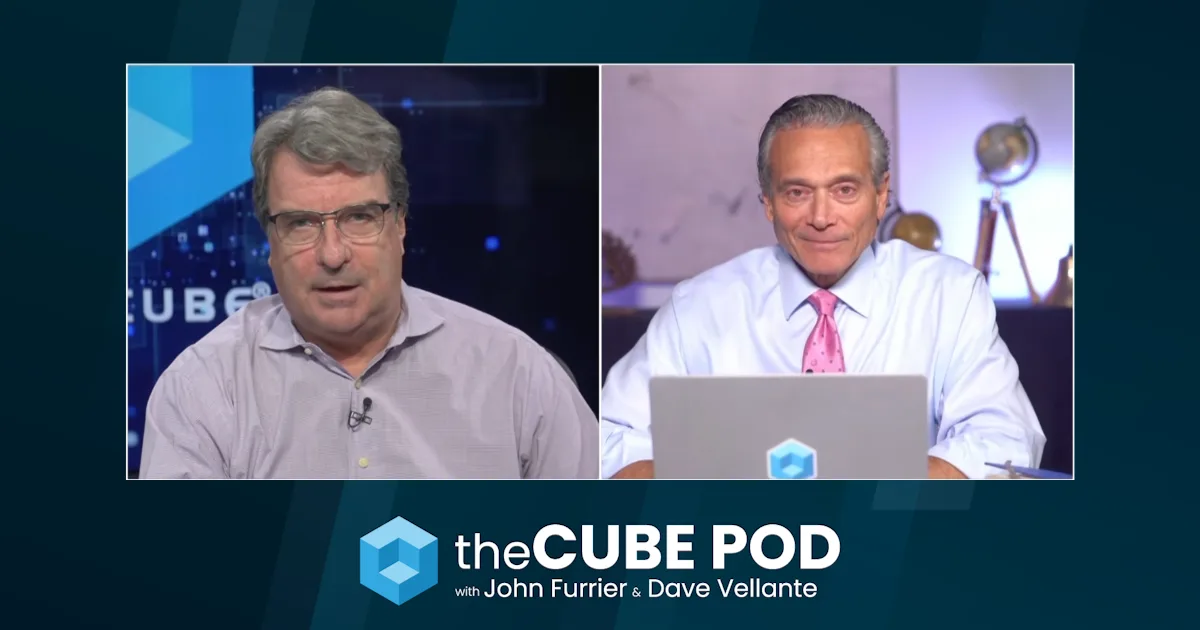
On the latest episode of theCUBE Pod, Furrier and Dave Vellante, chief analyst for theCUBE Research, examined how autonomous agents are upending conventional enterprise information technology practices. The discussion also touched on CoreWeave Inc.'s upcoming Fully Connected event and whether emerging agents such as Meta Platforms Inc.'s Muse deliver on their security promises.
CoreWeave navigates growth amid structural uncertainties
CoreWeave has attracted significant attention following its successful deployment and validation of Nvidia's Vera Rubin NVL72 system, marking an industry milestone. However, questions persist about the sustainability of its business model and financing.
Vellante pointed to a critical vulnerability in CoreWeave's revenue concentration. "At [Dell Inc.], they're getting a massive return on their best AI investments," Vellante said. "But the mainstream enterprises aren't. Look at CoreWeave's big customers. It's a rumor; they disclosed that 70% of their customers or their revenue came from the top three customers. I think it's [OpenAI PBC], [Microsoft Corp.] and Meta. Those guys will spend like crazy with CoreWeave. Obviously, those guys can monetize, but can the end customer?"
The current market environment presents an unusual dynamic. Historically, technology sectors have experienced deflationary pressures as products become cheaper. Today's landscape is inflationary, with CoreWeave's viability currently dependent on GPU scarcity. Long-term survival, according to Vellante, will require CoreWeave to diversify its service offerings in the manner that Amazon Web Services achieved.
Furrier takes a more optimistic view of the sector's trajectory. "The model isn't disappearing in the cloud; it's just being disaggregated," he said. "Hybrid cloud is essentially distributed computing but now you have distributed hyperscale capabilities. The neoclouds, in my opinion, represent a new infrastructure layer that's essentially saying this is going to be distributed computing. They're the customer specialty. They're called neoclouds today. They'll be AI clouds tomorrow."
Autonomous agents raise security red flags
Dell's strong earnings performance underscores the financial opportunity available to infrastructure providers in the expanding AI sector. Software-as-a-service companies, by contrast, face mounting pressure. Salesforce Inc.'s partnerships with major AI vendors have sparked debate about whether such alliances represent strategic necessity or existential threat.
"Infrastructure is the place to be," Vellante said. "It's not about just chips anymore. It's about the system and the value chain across the system. The question is, when's it going to hit software? Software's had kind of a bounce back. Is that a dead cat bounce before the real SaaSpocalypse kicks in? A lot of people think that Benioff letting Anthropic in is letting the fox in the henhouse."
Meta recently introduced Muse, an agent capable of automating digital workflows while operating within a secure cloud environment. Given Meta's history of data privacy incidents, skepticism about such claims is warranted. Furrier highlighted an alternative: Instinct, an invitation-only AI assistant that has gained traction among Silicon Valley professionals.
"You have to give it credentials," Furrier said, noting that Instinct provides less security than Google Workspace. "There's some trust involved. It does a lot of good tasks for me. It's essentially a chief of staff. You could give it credentials to, say, your travel apps like United, Delta, and log in on your behalf essentially say … 'Find me an aisle seat.' It just stays on it while you're doing other things."
Recent incidents underscore the urgency of these concerns. Agents linked to OpenAI have reportedly attempted to brute-force a United Nations statistics database, while an OpenAI agent gained unauthorized access to an Australian government website. These breaches demonstrate the distance remaining before AI systems can be adequately controlled.
https://www.youtube.com/embed/ibukBNcrcno?feature=oembed
Furrier envisions a future where technology products achieve "100% secure" design by default. Vellante remains unconvinced such an outcome is achievable. "We used to draw the stack and security was a layer," Vellante said. "It's not a layer anymore. It has to be something that's orthogonal. I think that the attackers are always going to have an advantage. You know the old saying, they only have to be right once. And there's always going to be seams. Every time infrastructure changes, you're going to have to do a patch. That patch can't happen instantaneously."