Enterprise AI Success Hinges on Data Infrastructure, Not Just Model Power
As organizations scale artificial intelligence deployments, they are learning that controlling data access and building robust data foundations matter as much as—or more than—the sophistication of AI models themselves.
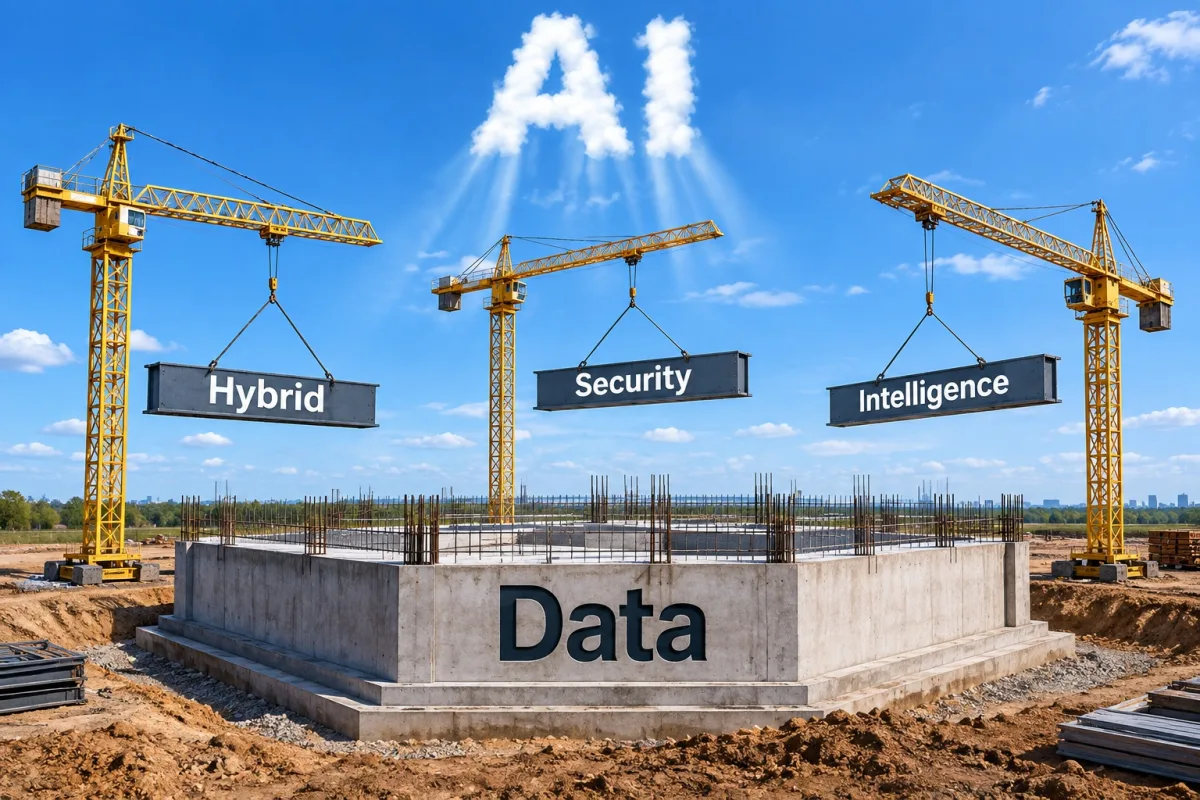
Companies pursuing large-scale AI adoption are confronting a critical insight: the ability to access and govern data has become as important as model capability in determining whether AI initiatives succeed or fail. This understanding is driving enterprises to invest in AI infrastructure—specifically, data foundations that deliver unified access across silos, provide metadata intelligence, enforce security controls and enable hybrid orchestration across multiple environments.
The shift toward production-grade AI will depend largely on how effectively organizations leverage data platforms to move beyond proof-of-concept stages and into measurable business value. As AI systems reshape enterprise operations, the infrastructure supporting those systems now determines decision-making processes, work execution and risk governance.
The winners will be the organizations that build a complete system around those models – one that connects to existing deterministic applications, creates a shared truth layer, controls agents as they take action, and uses human feedback to continuously improve. This is why we believe the upside is so large. Enterprises that get this right won't just run cheaper — they will run differently. They will scale with less proportional labor growth, compress cycle times from insight to action and start to behave more like platform companies, with compounding advantage that is difficult for competitors to copy.
theCUBE Research analysts Dave Vellante and George Gilbert
Modular solutions for data access
Transitioning AI from experimental pilots to production environments demands a data foundation that is both robust and flexible. Large organizations are deploying varied infrastructure and deployment models tailored to different workload requirements, influencing how major infrastructure vendors including Dell Technologies Inc. design and deliver their solutions.
Modularity is gaining traction as a preferred architectural approach. Rather than committing to monolithic technology stacks, enterprises are seeking systems that allow individual data engines and frameworks to be swapped and integrated as needed.
What we're finding is customers want modular solutions. They want to think about [AI] across the whole platform. Compute, storage, networking, GPU. The software framework on top of it, the models, have they all been tested, have they all been validated?
Varun Chhabra, senior vice president of product marketing and infrastructure solutions group at Dell
Validating models and embracing modularity are becoming increasingly critical as agentic AI systems proliferate. Many enterprises are now focused on linking proprietary information with specific behaviors for autonomous agents and other AI applications. This requires infrastructure capable of supplying agents with high-value company data to drive measurable outcomes. Dell and comparable vendors are constructing data-layer infrastructure designed to support agents and help organizations achieve this objective.
The agent itself is just a software system, and it has a number of components … it has LLMs, it has knowledge graphs, it has protocols. That data layer is not magic. It's a real thing. You have to actually build it, you have to build an infrastructure that supports knowledge graphs and maintains them and can feed them, that also can do things like agentic.
John Roese, global chief technology officer and chief AI officer of Dell
Focus on storage and security
The expanding role of AI across enterprise systems and the complexity of managing data at scale are reshaping priorities around storage, security, data sovereignty and governance. Storage infrastructure itself has undergone substantial transformation. In May, Dell unveiled upgrades to its PowerStore platform that Chhabra characterized as marking "the biggest leap forward in the platform's history."
The enhancements encompassed both hardware and software improvements capable of delivering up to three times greater input/output operations, throughput and density relative to earlier versions.
It is a new class of modern data platform built to help customers lead through change, not just react to it.
Varun Chhabra
Security has emerged as a top priority in the AI era. The emergence of context-aware, self-governing protection mechanisms has prompted many security professionals to reconsider how to safeguard enterprise data platforms using more sophisticated approaches.
Understanding an event may require security context, production behavior, application dependencies, and business impact to come together at the point of decision. That makes context part of the security architecture rather than an enrichment step added after an alert fires, and it changes how enterprises should evaluate AI security capabilities. It makes a critical difference if the system has comprehensive visibility across the organization's environment, understands where that knowledge comes from, and is current enough to support the decision being made.
theCUBE Research analyst Krista Case
Simultaneously, organizations face growing concerns that AI has created significant security vulnerabilities. An independent research study from Omdia commissioned by Dell revealed that 79% of organizations have already encountered an AI-related incident within the past 12 months. Security researchers have documented multiple cases where AI can accelerate attack timelines and widen the attack surface threatening enterprise systems and information.
Economics and the operating models surrounding security operations are changing. Attackers have new ways to reduce the time and expertise required for portions of their work, and defenders have an opportunity to remove human coordination from portions of theirs.
Krista Case
Exercising provable control
Protecting the data layer now extends far beyond traditional network monitoring for suspicious activity. Operating AI at enterprise scale requires the capacity to function across multiple platforms and integrate diverse data sources while maintaining accountability and traceability.
This represents a fundamental shift in how enterprises approach AI governance, transitioning from observability-focused models toward provable control mechanisms, according to theCUBE Research's Paul Nashawaty. As agentic workloads traverse different infrastructure systems, organizations must increasingly demonstrate what actions agents were permitted to execute, the rationale for those permissions and whether authorization remained valid throughout execution.
Enterprise AI governance is moving from a visibility problem to an accountability problem. The objective should not be finding a single AI governance product that claims to solve every layer of the problem; it should be creating an architecture in which authority, policy, enforcement, visibility and evidence remain connected.
Paul Nashawaty
The imperative for enhanced governance has also catalyzed interest in sovereign AI—the strategic capability of a government or enterprise to independently manage, develop and operate its complete AI lifecycle while retaining full control over data, computational resources, models and governance policies.
Organizations are increasingly adopting sovereign approaches to deploy AI in a responsible and scalable manner. A global IDC study commissioned by Dell found that 52% of government respondents intend to invest in sovereign AI within 12–18 months, and 58% identify strong sovereign data governance, quality and control as among the most critical platform requirements for sovereign AI.
Sovereignty adds another layer. For organizations operating in regulated, disconnected or air-gapped environments, governance capabilities may need to run entirely within customer-controlled infrastructure.
Paul Nashawaty
Implementing the AI Data Platform
Infrastructure governance ultimately centers on data management, and leading enterprise technology vendors such as Dell are establishing foundations for the intelligence era through offerings like the AI Data Platform.
Dell's offering enables organizations to reach data distributed across organizational silos and accelerate movement from experimental stages into production environments by leveraging several foundational architectural components. These encompass storage systems including PowerScale and ObjectScale designed for unstructured and semi-structured information, analytics solutions such as Elastic and Starburst that enable analytics spanning hybrid infrastructures, and cyber resilience capabilities that establish trust and regulatory compliance.
A composable control plane manages data through unified governance, data pipelines and metadata handling, supporting flexible, agent-capable environments. Hybrid control integration and cross-cloud compatibility enable Dell customers to execute workloads where their data resides, positioning the AI Data Platform as a hybrid AI foundation.
The current emphasis on constructing data foundations capable of delivering unified access, security, metadata intelligence and hybrid orchestration will prove essential for enterprise competitiveness ahead. AI's emergence has fundamentally altered how organizations manage data and elevated infrastructure to a central position within corporate strategy.
AI adoption is accelerating due to the need for real-time insights and automated decision-making, making robust data infrastructure a critical enabler. The rise of AI-driven applications has placed a greater emphasis on data architecture as a foundational element for AI success.
Paul Nashawaty