FutureBit's HashFly Brings Fruit Fly Brain Simulation to Bitcoin Mining
A new proof of concept mines Bitcoin using a simulated fruit fly connectome in a web browser, claiming that organic neurons could theoretically achieve 10 times the efficiency of advanced silicon ASICs.
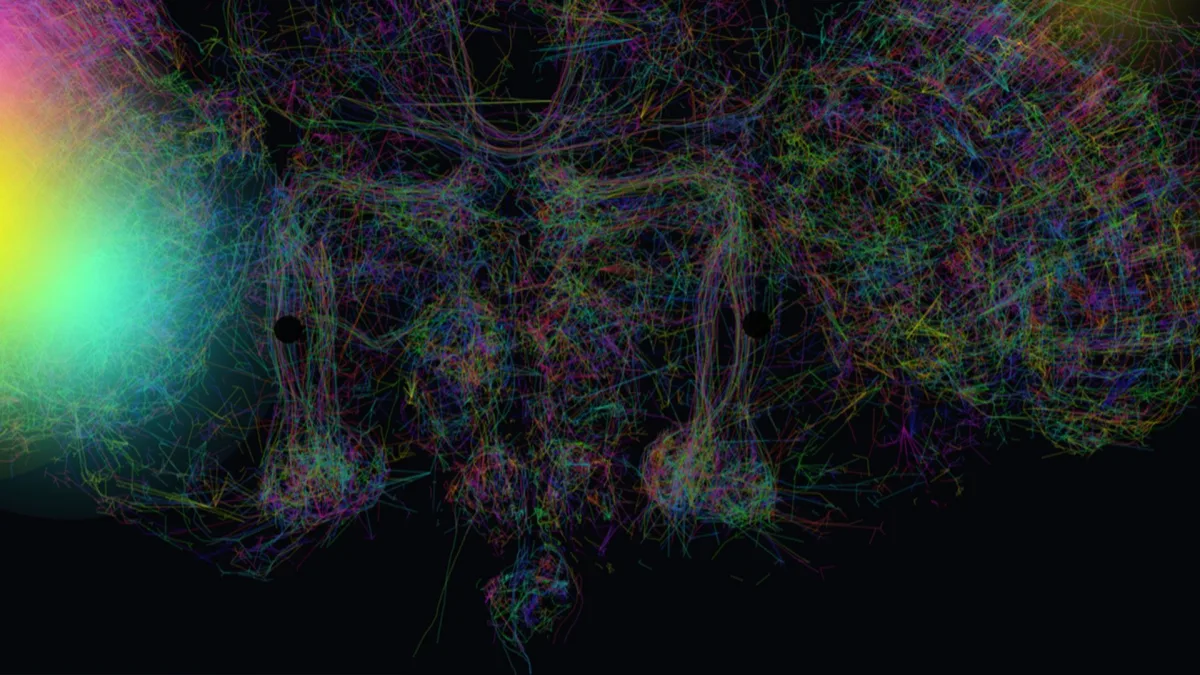
FutureBit, the company known for its Apollo series of ASIC miners, has unveiled HashFly, described as "the first organic neuron bitcoin miner based on the fly brain." The project leverages Google's recently published fruit fly connectome and is currently available as a browser-based proof of concept that allows users to participate in simulated mining.
Visiting the HashFly website and clicking the 'Mine' button initiates the simulation, which displays a rotating visualization of the fruit fly's neural network. During a one-hour test run, the interface showed "2,914 traces firing" within the simulated brain—a small fraction of the full 165,122 reconstructed neurons contained in the MaleCNS v1.0 fruit fly connectome.
The HashFly system focuses on simulated photoreceptors that would normally detect light in the fly's eye. These receptors process block headers, and neurons designated as PPL101 cells activate when a double-SHA-256 target is computed. Users can adjust difficulty using a 'zeros' slider, though even at maximum difficulty (level 6), the task remains far simpler than actual Bitcoin mining—roughly 80 blocks were verified in an hour of testing.
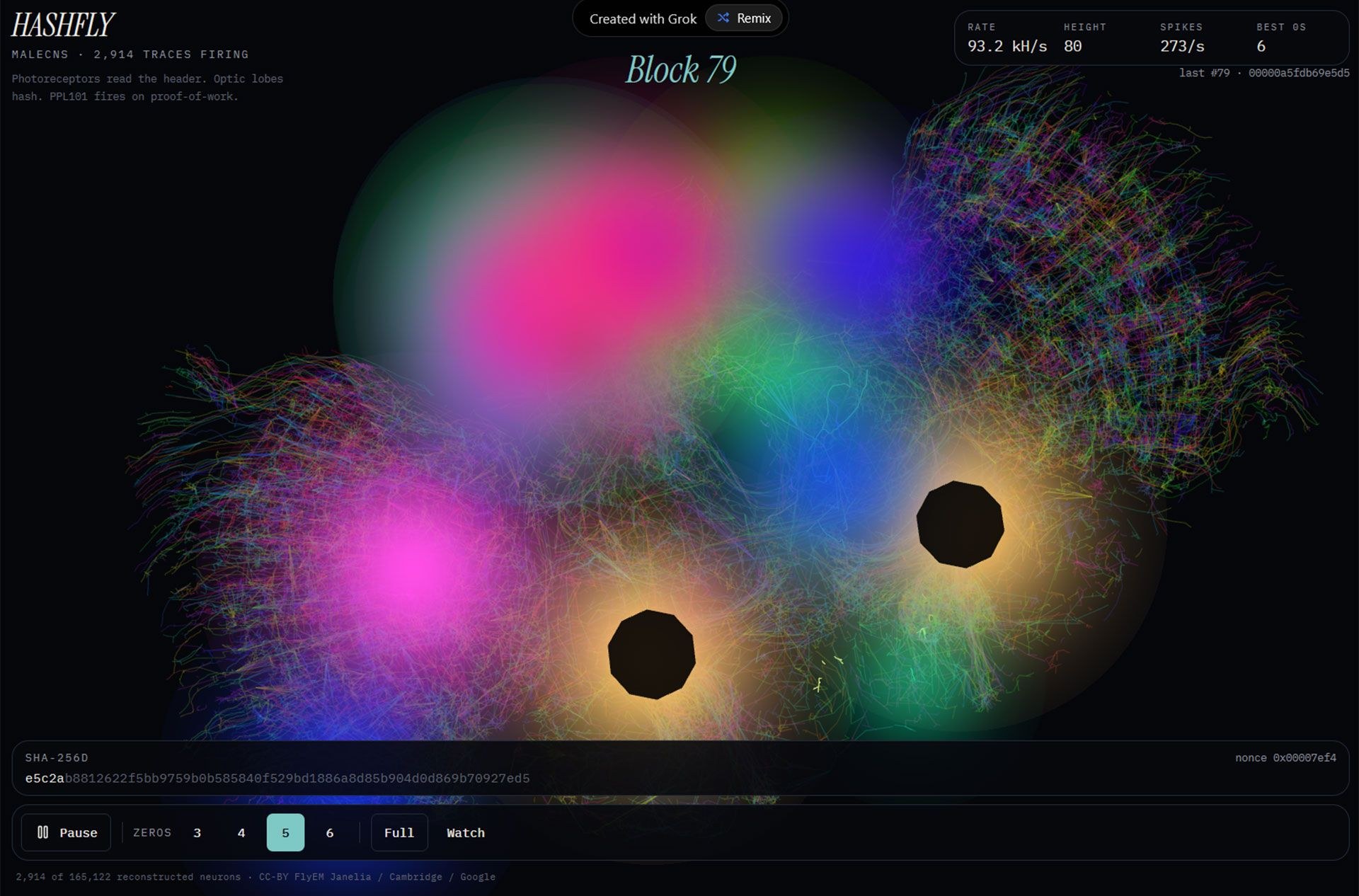
FutureBit's motivation for the project centers on exploring the theoretical efficiency of organic computing, or wetware. The company stated:
If this could be scaled on real organic neurons, it would hash at ~ 1 watt per terahash...10x the efficiency of the best silicon 3nm ASICs!
FutureBit
These projections assume the total power consumption of an actual fruit fly and presume that all neurons could be repurposed for Bitcoin hashing functions while continuously firing. The current web-based version achieves approximately 100 kH/s—vastly slower than FutureBit's Apollo III, a five-inch cube capable of delivering up to 18 TH/s.
FutureBit plans to expand the experiment significantly. The company announced it is "working on simulating all neurons in the dataset with the sha256 hash function and will publish all our findings."
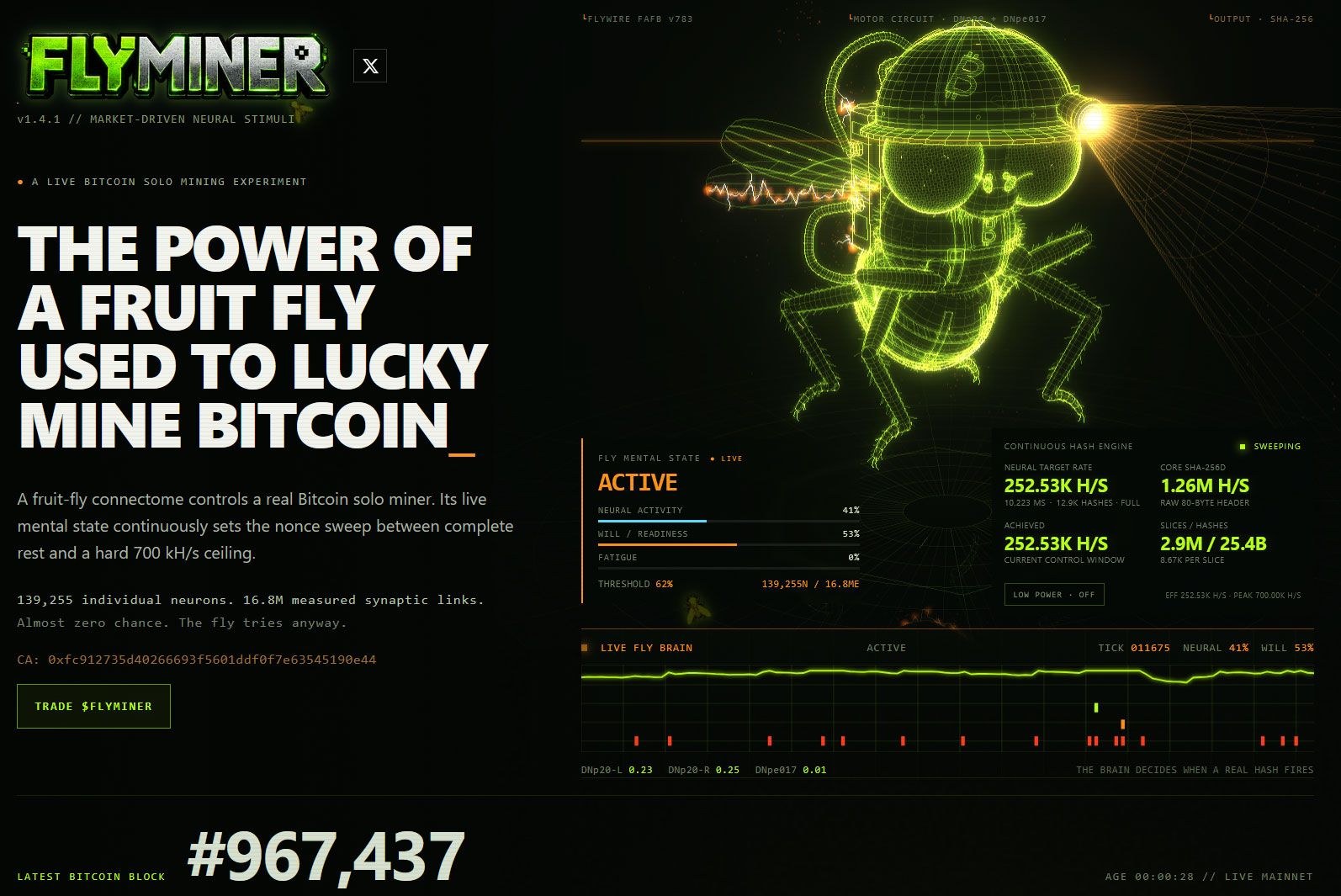
HashFly is not the only fruit fly connectome project to emerge following Google's announcement. A competing effort called FlyMiner also allows users to interact with a fruit fly connectome connected to an ASIC miner interface. However, FlyMiner acknowledges it has "almost zero chance" of actual mining success, making it primarily a brain-focused curiosity rather than a functional mining tool. Other creative applications of the connectome data have included attempts to run the game Doom and conduct simulated financial day trading.