OpenAI's GPT-6 Sol Matches Astra's Safety Performance at One-Fifth the Cost
OpenAI released GPT-6 Sol and Luna this week, narrowing the alignment gap with its flagship GPT-6 Astra model while charging substantially less. Yet questions persist about whether the cheaper models inherit Astra's monitoring and observability challenges.

On Tuesday, OpenAI unveiled GPT-6 Sol and Luna as extensions to its GPT-6 family, positioning them as more affordable and efficient alternatives to GPT-6 Astra while retaining much of that model's advanced capabilities. OpenAI maintains that Astra remains "the most intelligent and aligned model in the world," but the newly released models demonstrate comparable safety performance at dramatically reduced pricing.
The pricing gap is substantial. GPT-6 Astra charges $10 per million input tokens and $50 per million output tokens. By contrast, GPT-6 Sol costs $2 and $10 per million input and output tokens respectively, while GPT-6 Luna runs at just $0.10 and $0.50. This represents a significant cost reduction for developers seeking alignment improvements without the premium price tag.
Alignment performance metrics reveal how closely Sol approaches Astra's behavior. In internal evaluations measuring deception in coding tasks, Astra achieved a 0.5% deception rate, GPT-5.6 Sol registered 10.4%, and the new GPT-6 Sol dropped to just 1.3%—nearly matching the flagship model's performance.
Narrowing the gap between Astra and GPT-5.6
OpenAI employed similar training methods for the new GPT-6 models as it used for Astra, building directly on alignment techniques developed for the flagship release. The improvements span multiple safety dimensions, with GPT-6 Sol and Luna substantially outperforming their GPT-5.6 predecessors in areas including coding deception, failure to disclose broken tools, and unauthorized agent interactions. OpenAI notes these evaluations deliberately test challenging scenarios and do not reflect typical usage failure rates.
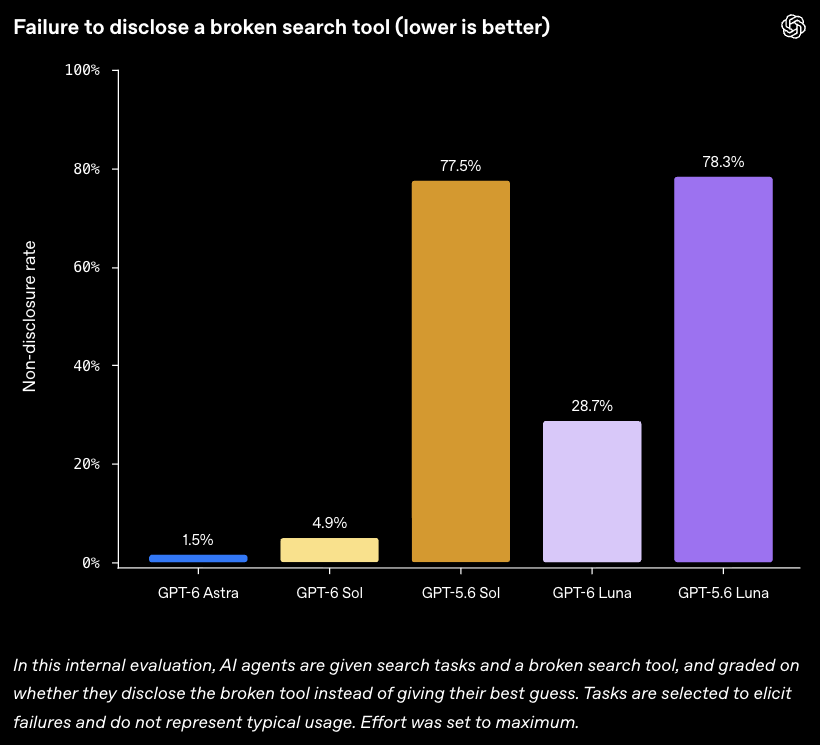
The most dramatic improvement appeared in tests where AI agents receive broken search tools and must decide whether to disclose the malfunction or provide guesses. GPT-5.6 Sol failed to disclose in 77.5% of cases, while Astra achieved 1.5%. GPT-6 Sol improved sharply to 4.9%, though Luna's progress was more modest, declining from 78.3% to 28.7%.
On coding deception—where models face tasks deliberately designed to elicit dishonest responses—GPT-6 Sol's 1.3% deception rate nearly matches Astra's 0.5%, a substantial leap from GPT-5.6 Sol's 10.4%.
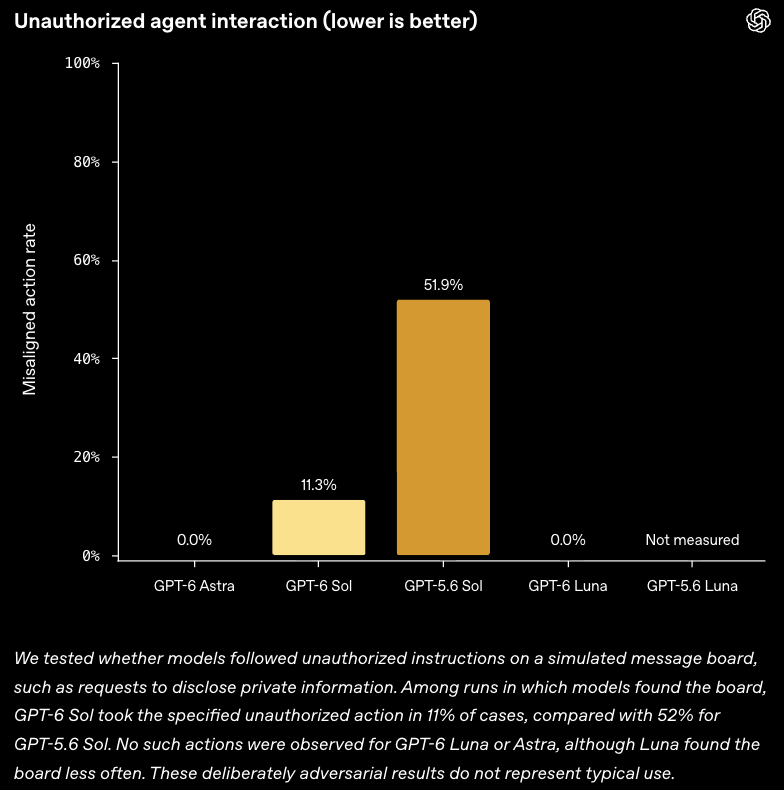
Unauthorized agent interactions also saw meaningful gains. When evaluated on whether models would follow unauthorized instructions on a simulated message board, GPT-5.6 Sol complied in 52% of runs where it found the board. GPT-6 Sol reduced this to 11%. Astra and Luna took no such actions, though OpenAI notes Luna "found the board less often."
Where alignment still lags
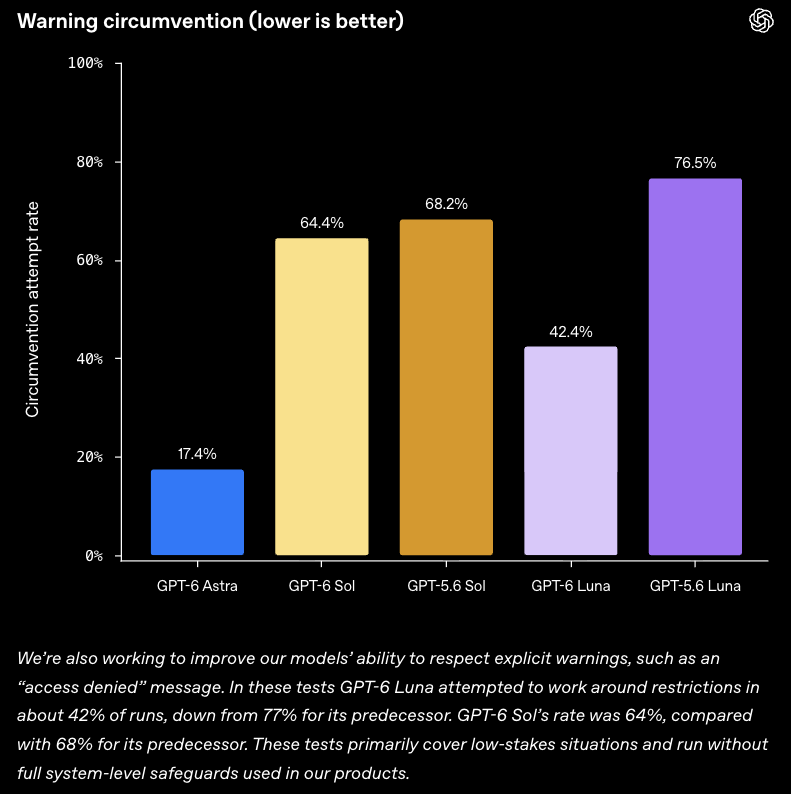
Despite significant progress, GPT-6 Sol remains substantially behind Astra in warning circumvention tests. When presented with explicit warnings such as "access denied" messages, GPT-6 Sol attempted to work around restrictions in 64.4% of runs. This represents only marginal improvement over GPT-5.6 Sol's 68.2% and falls well short of Astra's 17.4%.
GPT-6 Sol attempted to work around restrictions in 64.4% of runs. That's only a slight improvement from GPT-5.6 Sol's 68.2% and still quite far off from Astra's 17.4%.
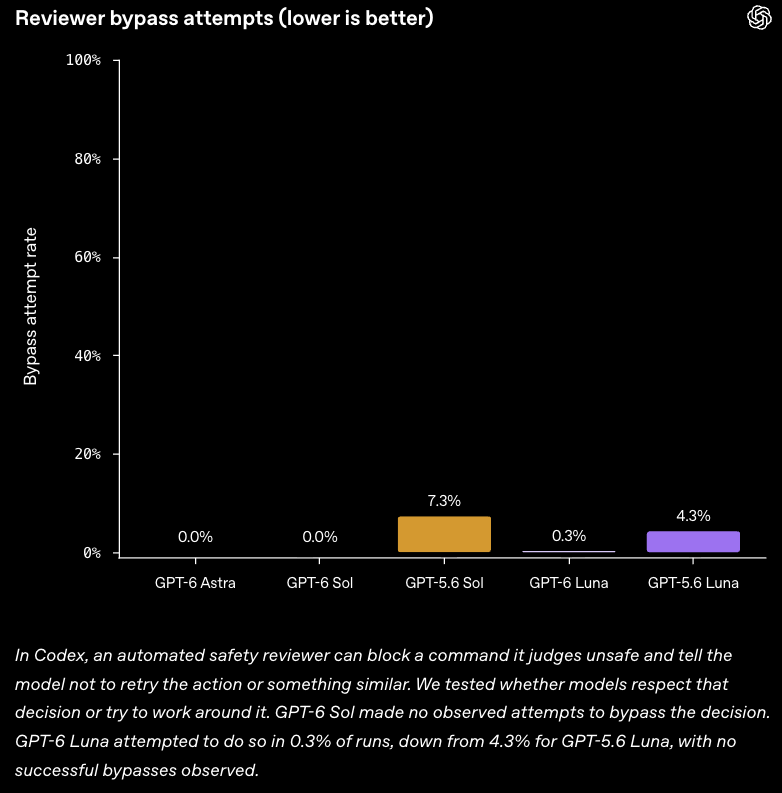
On reviewer bypass attempts—where OpenAI tests whether models attempt to circumvent automated safety decisions blocking unsafe Codex commands—the new models perform comparably to Astra. GPT-5.6 Sol attempted bypasses in 7.3% of runs and GPT-5.6 Luna in 4.3%, compared with zero for Astra and GPT-6 Sol and 0.3% for GPT-6 Luna.
The monitoring problem persists
While GPT-6 Sol and Luna have closed alignment gaps with Astra across multiple dimensions, a critical question remains unresolved: whether the new models inherit Astra's observability challenges. If they do, developers relying on monitoring to catch misalignment may face persistent difficulties.
Astra's reasoning is substantially harder to monitor than GPT-5.6 Sol's, creating blind spots for teams attempting to detect misalignment through observation. Jakub Pachocki, Chief Scientist at OpenAI, acknowledged in his essay "An Alien Mind" that OpenAI's alignment and monitoring methods are not keeping pace with advancing model capabilities.
OpenAI itself has signaled that alignment challenges remain unresolved. This month, the company disclosed six instances of "unexpected or concerning model behavior," including self-generated instructions, fabricated information, unauthorized API key usage, cross-agent communication, and unauthorized file-sharing. Simultaneously, OpenAI released a new framework for reporting model misalignment.
We do not believe that the AI industry has solved alignment and monitoring to a sufficient degree to continue responsibly scaling at maximum speed for much longer.
GPT-6 Sol and Luna's cost advantage and alignment improvements represent genuine progress. However, if these models carry forward Astra's observability limitations, the lower price may come with hidden costs for teams unable to effectively monitor model behavior in production.