Vicharak's Axon-Lite Swaps Interface Modules Instead of Boards
A new ARM single-board computer from Vicharak lets developers plug in different interface modules for voice, vision or sensing tasks, rather than stacking HATs or buying new hardware.
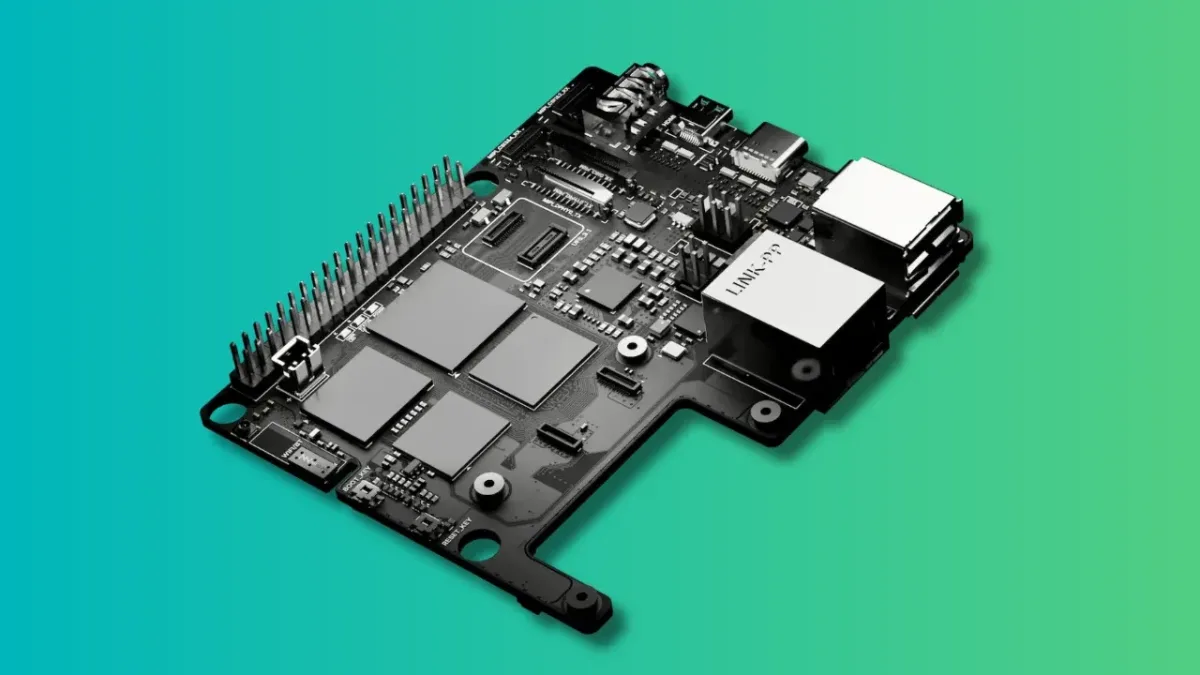
Building with a single-board computer typically locks you into a fixed set of capabilities. Start with a vision project, and your next idea might demand audio processing or sensor integration—forcing you to either stack expansion boards on the GPIO header or purchase an entirely new SBC. Vicharak is pursuing an alternative with the Axon-Lite, a compact ARM board whose interface modules snap in and out to match whatever task lies ahead.
The concept of reconfigurable computing is what sets this ARM board apart from conventional offerings. Vicharak is not new to the space: the company already produces a FPGA-based Vaaman and an RAM-based Axion line. The Axon-Lite represents the entry point in its Axon family, suggesting the company has some experience despite being relatively recent to the market.
Axon-Lite Specifications
- SoC: Rockchip RK3576 (4× Cortex-A72 + 4× Cortex-A53)
- AI/graphics: 6 TOPS NPU, Mali-G52 MC3 GPU, 16MP ISP
- Memory & storage: LPDDR5 (2GB–8GB), eMMC 5.1 (32GB–128GB), UFS 3.1, SD card
- Modularity: swappable interface modules + board-to-board expansion
- Connectivity: Wi-Fi 6, Bluetooth 5.2, Gigabit Ethernet
- GPIO: Raspberry Pi-compatible 40-pin header
Modularity is the headline feature. The board employs what Vicharak terms its modular connector interface, allowing users to attach different interface modules as requirements shift. The company currently demonstrates four options: Voice Processing, Smart Sensing, AI Data Hub and AI Vision. Beyond swappable modules, board-to-board expansion lets you stack a daughter board instead.
One caveat deserves attention: a modular connector is only as valuable as the ecosystem of modules actually available for it. Since this appears to be a proprietary interface rather than an open standard, users will depend entirely on what Vicharak chooses to release.
At the board's core sits a Rockchip RK3576, an eight-core processor positioned between the entry-level RK3566 and the high-end RK3588—a practical choice for edge computing tasks. Vicharak specifies a 6 TOPS NPU, matching the neural processing power found on considerably more expensive RK3588 boards, sufficient for running vision and other machine learning models directly on the device. The company states the SoC uses TSMC's 5nm process.
Storage and memory offer flexibility. LPDDR5 handles RAM, while storage options include eMMC 5.1, UFS 3.1 and microSD support. The inclusion of faster UFS on a board of this size represents a meaningful addition.
For vision-focused builds, input and output connectivity is extensive. The board provides a 4-lane CSI plus two additional 2-lane CSI paths for cameras, a 4-lane DSI for displays, a 16MP ISP, micro HDMI 2.1 and USB-C with display output. Wireless and wired networking include Wi-Fi 6, Bluetooth 5.2 and Gigabit Ethernet. A Raspberry Pi-compatible 40-pin GPIO header ensures compatibility with existing add-ons and pinouts. On-board battery charging circuitry hints at support for portable, battery-powered applications.
Software and Userbase
Vicharak positions the Axon-Lite as a Linux-first platform, built around a familiar Debian-style environment with standard apt-based package management. No unfamiliar learning curve here.
The tooling roster includes what you would expect: VS Code, Git, Python, Docker and Node.js for general development work, alongside ROS 2, OpenCV, GStreamer, FFmpeg, Jupyter, TensorFlow Lite and ONNX Runtime for those working in AI, robotics and computer vision.
Combined with the swappable modules, the intended audience spans a wide range: students experimenting with AI and embedded systems, hobbyists, and product teams prototyping edge AI and vision applications.
Pricing and Availability
The Axon-Lite is open for pre-order in 4 GB and 8 GB RAM configurations, priced at Indian rupees 15,930 (approximately US $165) and 18,299 (approximately US $200) respectively. Shipments are scheduled for January 2027. Buyers should account for shipping and customs duties.
Alternative single-board computers continue to emerge, and those offering something genuinely different from the established options merit attention.