AWS Releases Open-Source AI Agent Framework, Claims 45% Cost Advantage Over Claude Code
Amazon Web Services has unveiled Strands Harness, an open-source general-purpose AI agent that developers can run locally or in the cloud. AWS benchmarks show the framework cuts costs compared to competing solutions, though a rival harness still undercuts it.

Amazon Web Services has introduced Strands Harness, a new open-source, general-purpose AI agent framework designed to provide developers with a pre-built foundation deployable either on local machines or cloud infrastructure. The tool expands on Strands Agents, which AWS released in May 2025 as an open-source Python SDK for constructing AI agents.
Strands Harness operates on what AWS describes as a "model-driven approach," where developers supply the underlying model, tools and instructions while the model itself decides how to execute tasks and when to invoke those tools. AWS has since extended Strands support to TypeScript and established Strands Labs in February as a dedicated space for experimental work.
Marc Brooker, VP and distinguished engineer at AWS, explained to The New Stack that Strands Harness functions as a layer above the existing Strands SDK, offering developers a pre-configured Strands Agent. The framework consolidates the tools and infrastructure an agent requires for extended operations, with AWS furnishing default configurations for how these components interact.
An SDK like the Strands Harness SDK gives you the building blocks, but you still need to decide how to manage context, persist conversations, integrate tools, and guide the agent's behavior.
Marc Brooker, VP and distinguished engineer at AWS
Core Capabilities and Customization
Strands Harness ships with a functional agent that includes file, shell and web tools, along with integrated support for context handling, memory management, persistent sessions, prompt caching and delegation between agents. Developers can customize individual agents for specific purposes by modifying instructions, selecting models, controlling available tools and capabilities, and determining whether agents can delegate work to other agents.
Most of Strands Harness operates independently of AWS infrastructure. The agent loop, tools, context management, session handling and delegation are all part of the open-source release and execute on the machine running the agent by default. The primary exception involves calls to the underlying model, which AWS routes through Amazon Bedrock, its managed service for accessing and operating foundation models.
However, this default can be readily substituted. Brooker noted that "this is easily overrided to use a different model provider with one line." Strands Harness can alternatively leverage Anthropic, OpenAI or Google as model providers, or employ a locally-running model through Ollama. Selecting a different provider does not necessarily require changing the underlying model, though Brooker acknowledged that choosing a different model will naturally influence agent behavior.
Different models have different strengths on reasoning, tool use, and cost. What doesn't change: context management, sessions, tools, delegation all work the same regardless of provider. No features require Bedrock.
Marc Brooker
All other defaults remain customizable as well. Developers can integrate their own tools and skills, connect MCP servers, modify context handling approaches, and select where session state gets stored.
Developers can focus on their application's task and domain expertise, while customizing the components that need different behavior.
Marc Brooker
Intended Use Cases and Features
AWS positions Strands Harness as a general-purpose agent rather than a specialized coding assistant, though it draws inspiration from frameworks such as Claude Code and Codex. According to AWS, the key distinction lies in deployment flexibility: Strands Harness can be deployed to any cloud provider, addressing what the company identifies as a widespread developer desire to run the same setup across different cloud environments rather than being locked into a single platform.
The framework includes a command-line interface for prototyping and configuring agents interactively. Developers can select a model, incorporate prompts, tools and additional capabilities, then export the resulting agent as Python or TypeScript code using /export.
AWS provides an Agent Skill designed to help coding agents understand Strands Harness itself, including how to add MCP servers or generate deployment configurations for providers such as AWS, GCP, Azure, Cloudflare and Modal.
Performance and Cost Benchmarks
AWS testing indicates that how a harness manages surrounding agent machinery can significantly impact cost and performance, even when the underlying model remains constant. The company averaged its performance across six benchmarks—ALFWorld, ContextBench, GAIA, WebShop, τ³-bench and Terminal-Bench 2.1—and compared results with average cost per task across the same tests.
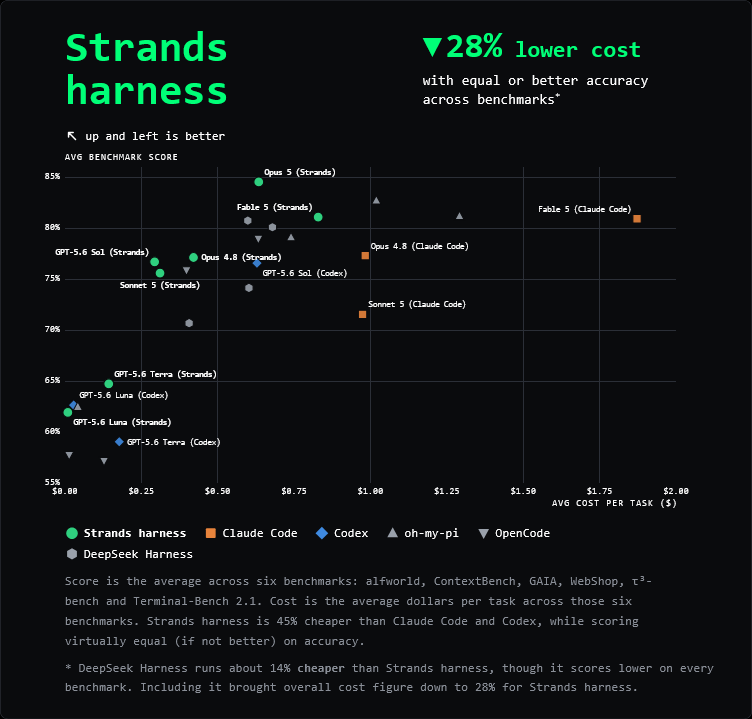
Against Claude Code and Codex specifically, AWS reports that Strands Harness achieved 45% lower costs while maintaining broadly comparable accuracy. That advantage narrows to 28% when DeepSeek Harness, which AWS says ran approximately 14% cheaper than Strands Harness on equivalent runs, is included in the comparison.
AWS attributes much of this cost efficiency to its context-management defaults. Strands Harness truncates particularly large tool outputs, compacts context once the available window exceeds a set threshold, and attempts recovery within the agent loop if context overflows.
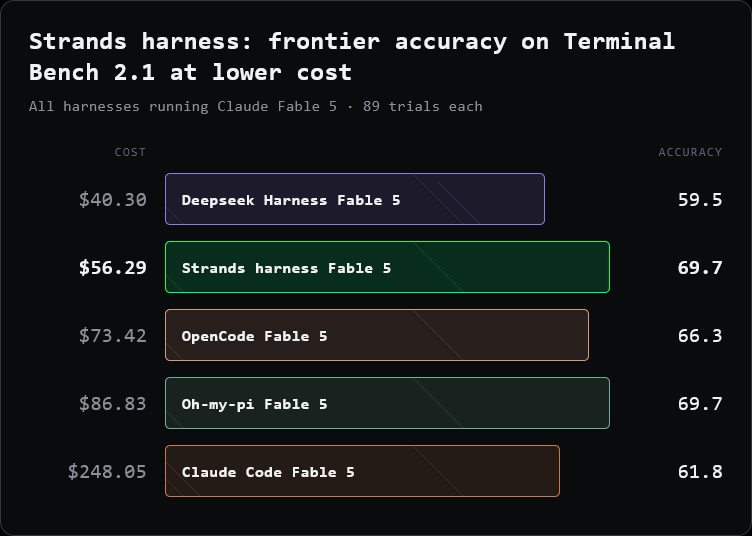
On Terminal Bench 2.1 specifically, AWS reports that Strands Harness running Fable 5 cost 77% less than Claude Code, at $56.29 versus $248.05 across 89 trials, while achieving a score of 69.7 compared to 61.8. DeepSeek Harness was cheaper still at $40.30, though its score was lower at 59.5.
Getting a prototype working is one step; evaluating how those choices affect performance and cost is another. The opportunity we saw was to package that engineering into a complete, general-purpose agent.
Marc Brooker
AWS's Commercial Strategy
AWS has a clear commercial incentive to promote Strands Harness adoption. Amazon Bedrock AgentCore serves as the company's managed service for deploying and operating agents, offering identity and access controls, observability and the infrastructure required to host them.
A close technical relationship exists between the open-source project and the managed offering. AgentCore Harness and Strands Harness were developed by the same team, though they reside in separate codebases. Brooker indicated that work on one can inform improvements in the other, creating a pathway for technology developed in the open-source project to enhance the managed service, and vice versa.
Brooker reiterated that Strands Harness can be deployed independently of AgentCore and outside AWS entirely. "AgentCore is an optional hosting layer for teams that want AWS to manage the infrastructure side," he stated. "However, all deployment paths are open for the developer to choose."
This arrangement establishes a clear business model for AWS: developers can adopt Strands Harness at no cost, while AgentCore provides a natural destination for teams that eventually seek AWS to manage their infrastructure layer.