Blitzy's $1.4B Bet: Knowledge Graphs as the Foundation for Safe Autonomous Coding
As enterprises demand coding agents that can handle massive, interconnected systems, Blitzy is using graph databases to give AI the contextual understanding needed to modify codebases safely at scale.
The shift toward autonomous software development is pushing knowledge graphs into a central role, as companies move beyond having coding agents handle isolated fixes and toward letting them work across sprawling, interconnected systems. The challenge intensifies with scale: the larger the codebase an agent must navigate, the more it needs to comprehend about the dependencies and relationships woven throughout that code.
Investors are backing companies that tackle this architectural problem directly. Blitzy Inc. secured $200 million in funding at a $1.4 billion valuation in May, positioning itself to run thousands of coding agents in parallel. The real bottleneck in autonomous coding is not the generation of code itself but rather the agent's grasp of the broader system it is modifying, according to Neeraj Deshmukh, director of engineering at Blitzy.
I think when people talk about changing software autonomously, the biggest problem is not whether AI can write code. It's about does AI know or understand the system that it's writing the code for?
Neeraj Deshmukh, director of engineering at Blitzy
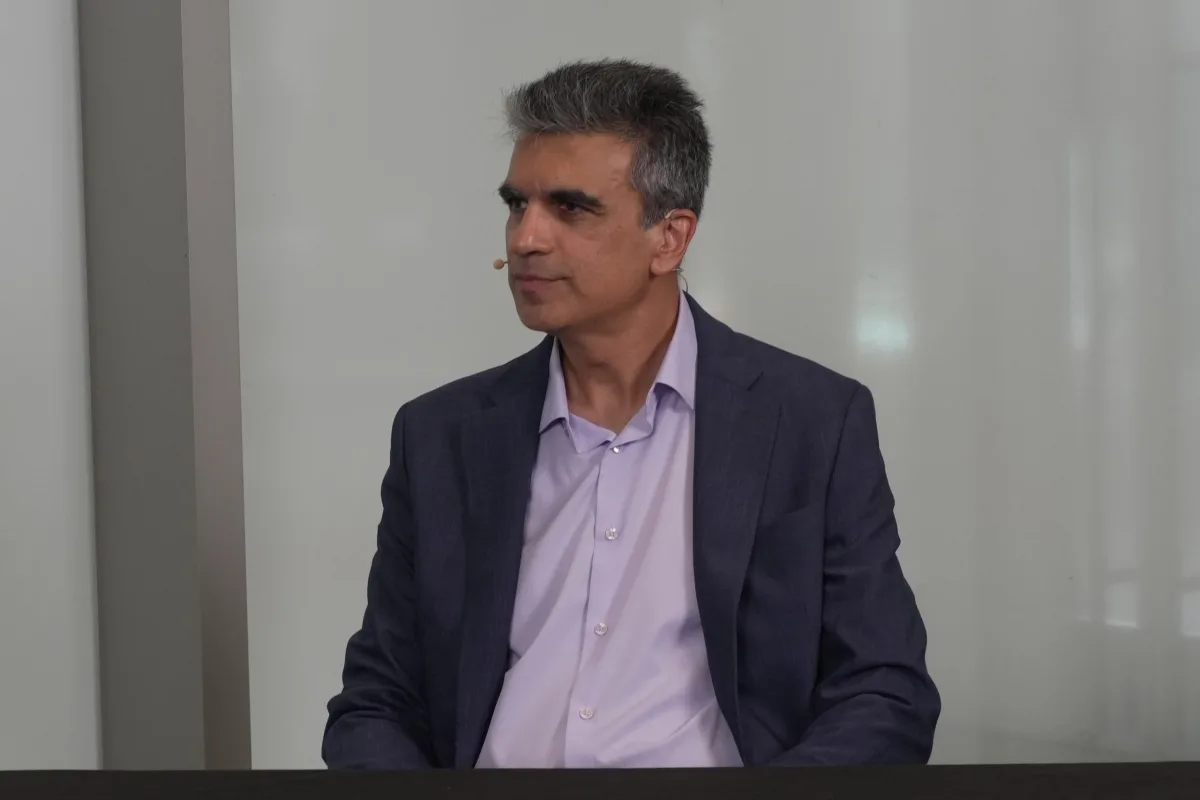
Deshmukh elaborated on why this understanding matters: "The reason that understanding is crucial is because I may be changing a line of code here, but it may have downstream impact somewhere far away." He shared these insights during an exclusive interview at GraphSummit, speaking with theCUBE Research's John Furrier. The discussion centered on how Blitzy leverages a graph database from Neo4j Inc. to equip its coding agents with the context required to modify enterprise codebases both securely and at scale.
Why knowledge graphs fit the shape of code
Blitzy's approach begins by analyzing a customer's existing infrastructure and constructing a dynamic graph representation of the codebase. This graph integrates with version control platforms including GitHub and GitLab, refreshing itself whenever developers or agents introduce changes. The decision to employ knowledge graphs for this purpose reflects a fundamental characteristic of how software is structured, Deshmukh explained.
Fundamentally, code is a graph because you think about, 'Oh, we have modules, we have files, we have functions, we have objects, we have classes, variables.' Each of these are entities that are related to each other. So even before you bring AI into the picture, a codebase is a graph intrinsically.
Neeraj Deshmukh
Without this structured representation, agents resort to vector searches or grep commands to identify dependencies, a method that rapidly exhausts the agent's available working memory. An agent's practical context window reaches a ceiling of roughly 200,000 to 300,000 tokens, translating to approximately 20,000 to 30,000 lines of code, Deshmukh noted. When confronted with a 100-million-line codebase, agents begin condensing their findings and discarding information.
With a graph, you know exactly what you're going to reach because you basically get to pick the point where you want to start. And you know exactly what is accessible. And so you have that effective context. Every agent knows the context that it needs to and nothing else.
Neeraj Deshmukh
This efficiency gain reshapes how work gets organized. Because less context gets lost in expansive searches, Blitzy can address complete projects in one go rather than fragmenting them into the epics, user stories and tasks typical of conventional sprint planning. The platform embeds quality assurance directly into its workflow: a human reviews and approves an Agent Action Plan before any code generation occurs, and every line of generated code undergoes immediate testing. In June, the company reported an 84.95% score on SWE-Bench Pro.
On top of that, we have agents who are watching other agents to make sure that they abide by the spec, the plan that we had created and approved by the human in the loop. That ensures that there is no drift or hallucination.
Neeraj Deshmukh
The selection of query language carries significance as well. Neo4j used GraphSummit to promote knowledge graphs as a shared context layer for AI agents, and Blitzy's agents continuously execute queries using Neo4j's Cypher language. Cypher's rigid syntax serves as an additional safeguard: when a hallucinating agent produces a malformed query, it simply yields no results, according to Deshmukh.
https://www.youtube.com/embed/j8P2nLXLldI?feature=oembed
You only get a result for a correct query. So there is no question of the agents working off of made-up information or something false. You're always grounded in truth of what's in the knowledge graph.
Neeraj Deshmukh