Graph RAG: When AI Needs to Follow the Connections Between Facts
Graph RAG combines vector search with explicit relationship mapping to help AI systems answer complex questions that depend on how different pieces of data connect to each other.

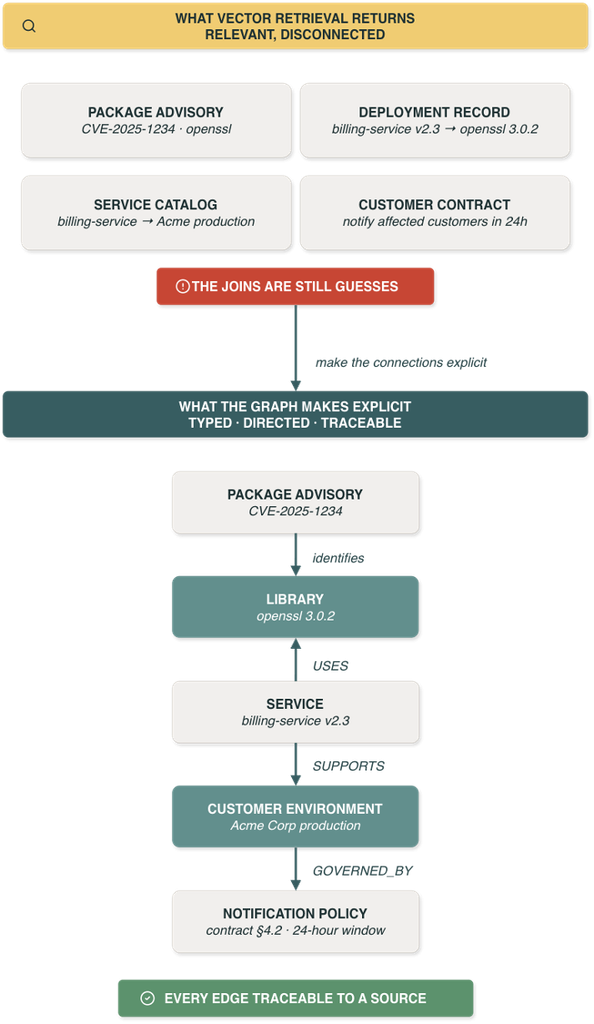
Consider a security scenario: a vulnerable library is discovered, a service depends on that library, customers use that service, and contracts govern what notifications those customers must receive. A traditional vector search might retrieve the advisory and service description separately, but it cannot reliably establish why these particular facts belong together. The missing piece is the chain of connections between them.
This is where Graph RAG becomes valuable. Rather than asking an AI system to infer relationships from similar passages, Graph RAG makes those connections explicit. As one practitioner put it: "Use it when the relationships among facts are part of the evidence behind the answer."
Where vector retrieval excels
Vector search finds text and records based on semantic similarity, even when different words describe the same concept. A question about "ending a subscription" can locate an article about "account cancellation." A query about memory management can surface papers discussing "context pruning."
This approach works well for many RAG applications. Documentation, support articles, and product descriptions typically contain answers within one or two passages. The data is largely unstructured text, questions have narrow scope, and the system does not need to prove connections across multiple business records.
Similarity scoring ranks likely evidence but cannot establish ownership, dependency, authorization, or policy scope. Two records can be semantically similar yet operationally unrelated. Conversely, directly connected records may share almost no common language. This distinction matters: "A similarity score is an opinion about relevance, while a tenant boundary, effective date, or account identifier is a condition the system must enforce."
Questions that demand relationship evidence
Once an AI agent moves beyond a single knowledge base, questions about connected systems become common:
- Which services depend on this component?
- Who can approve an exception for this account?
- Which customers are affected by this deployment?
- Which controls apply to the data in this environment?
The vulnerability scenario requires four records and three relationships. Text can describe each step, but an agent assembling the chain implicitly risks joining the vulnerable library to the wrong service version, associating a shared service with an incorrect customer, retrieving an expired policy, or missing a dependency updated after documentation was published.
A graph makes these connections explicit by representing each record as a node. Typed, directed edges record that a service USES a library or SUPPORTS an environment. A GOVERNED_BY edge ties a contract to a policy. Each connection carries its source and owner, with confidence scores or effective dates when relevant.
How Graph RAG adds relationship evidence
The term Graph RAG has multiple meanings. Microsoft's GraphRAG uses a language model to extract a knowledge graph from unstructured text, builds a community hierarchy, and supports both corpus-level and entity-focused queries. A narrower approach—and the focus here—uses a graph built from relationships already recorded in operational systems, where every edge traces to a documented source rather than being inferred from a model's interpretation of documents.
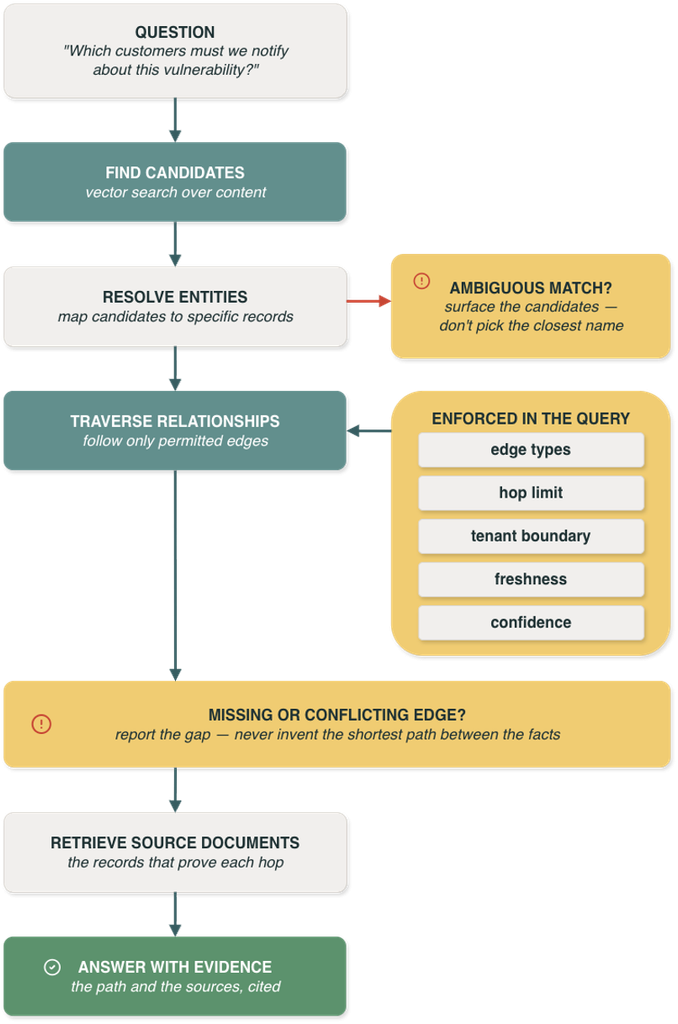
This method combines content retrieval with traversal over known relationships. A practical flow begins by finding candidate entities and passages, resolves those candidates to specific records, follows only permitted relationships, and retrieves source documents to explain the result. The resolution step is the hardest part. A question about "the payments service" must land on the correct record when the catalog lists three services with similar names. An incorrect match affects every subsequent hop. When ambiguity exists, the application should surface the candidates rather than select the closest name.
"The graph answers 'What is connected?' The source material answers 'What does the policy say?' You need both." A path from a customer to a contract does not contain notification terms unless those terms are modeled in the graph itself. Copying every paragraph into the graph creates another version of the truth to maintain.
Traversal requires limits. Specify which edge types a request may follow, how many hops it can take, which tenant or account boundary applies, how current each connection must be, and what confidence is acceptable. Apply these limits as query and access constraints before results reach the model, not as suggestions in the prompt.
Missing edges matter. If a service has no recorded owner or two records disagree about which contract is active, the agent should report that condition rather than infer a path. "I can identify the affected service, but I can't verify its current owner" is a useful answer. An unsupported conclusion during an incident can send notifications to the wrong customers.
The graph therefore needs an owner and a defined update path, just like the operational data behind it. Its access rules must preserve enough provenance for audit history. Otherwise, undocumented assumptions may appear as authoritative-looking edges.
Keep the graph near operational data
Many relationships already exist in relational tables. A foreign key connects a service to a team. A deployment table connects a service version to an environment. An entitlement table connects a customer to a product. Copying these facts into a separate graph system creates update delays and another permission model. It also leaves an uncomfortable question during every investigation: Which copy is current?
Oracle AI Database offers one option when graph and vector search need to stay near the relational records they depend on. SQL property graphs can be defined over existing tables and views, then queried through GRAPH_TABLE. AI Vector Search can rank related text in the same database. This allows an application to use graph patterns against current business data, then add semantic retrieval without turning every lookup into a reconciliation job across several stores.
The query itself is plain SQL. Finding every service that uses OpenSSL, along with the customer environments those services support, is a single pattern match:
SELECT *
FROM GRAPH_TABLE (ops_graph
  MATCH (lib IS library WHERE lib.name = 'openssl')
         (env IS customer_environment)
  COLUMNS (svc.name AS service_name, env.customer_id AS customer_id)
);
The decision rule matters more than the specific database. The platform should let the team inspect the exact path the agent used and trace each node and edge to its source, under the same access rules that protect the underlying records. If moving the relationships breaks those properties, the copy makes the answer harder to validate.
Choose Graph RAG for defined questions
Before adding a graph, ask one question: Does the answer require joining facts across entities, following dependencies, or proving why one record applies to another?
Repeated multi-hop questions are a strong signal. So are decisions controlled by ownership, entitlements, dependencies, or policies. Incidents caused by missing or stale connections give an even clearer starting point because the consequences of an unsupported path are already understood.
A self-contained knowledge base probably does not need Graph RAG. Neither does a workload where one document usually answers the question. And if no operational system owns the relationships, building a graph will not fix the underlying data problem. It may only hide it behind a nicer query interface.
Pilot one decision instead. Impact analysis is a good candidate: given a component change, identify the affected services and customers, then cite the records that establish each connection. Entitlement-aware support is another: determine which product and policy apply to an account before retrieving the support guidance.
Use known source data and define success before building. Check whether the agent resolved the right entities and followed current relationships within the allowed boundary. Verify that the retrieved documents support the answer. "Evaluate the path as carefully as the prose it produces, because a fluent response may not reveal an incomplete join."
Better context needs better evidence
A graph is useful only if it supplies evidence the agent cannot reliably retrieve in another way. Start with relationships people already use to make a decision, then prove that making those connections explicit improves the result.
Vector retrieval will still find the advisory and the contract language. The graph explains why they belong in the same answer. If the agent cannot show both the facts and the connections behind its conclusion, it should communicate the remaining uncertainty.