openKylin 3.0 Positions Chinese Linux Desktop as AI-First Operating System
The latest version of China's open-source operating system integrates an AI agent framework and voice-controlled assistant at the core, alongside updates to its UKUI desktop environment and new Rust-based utilities.
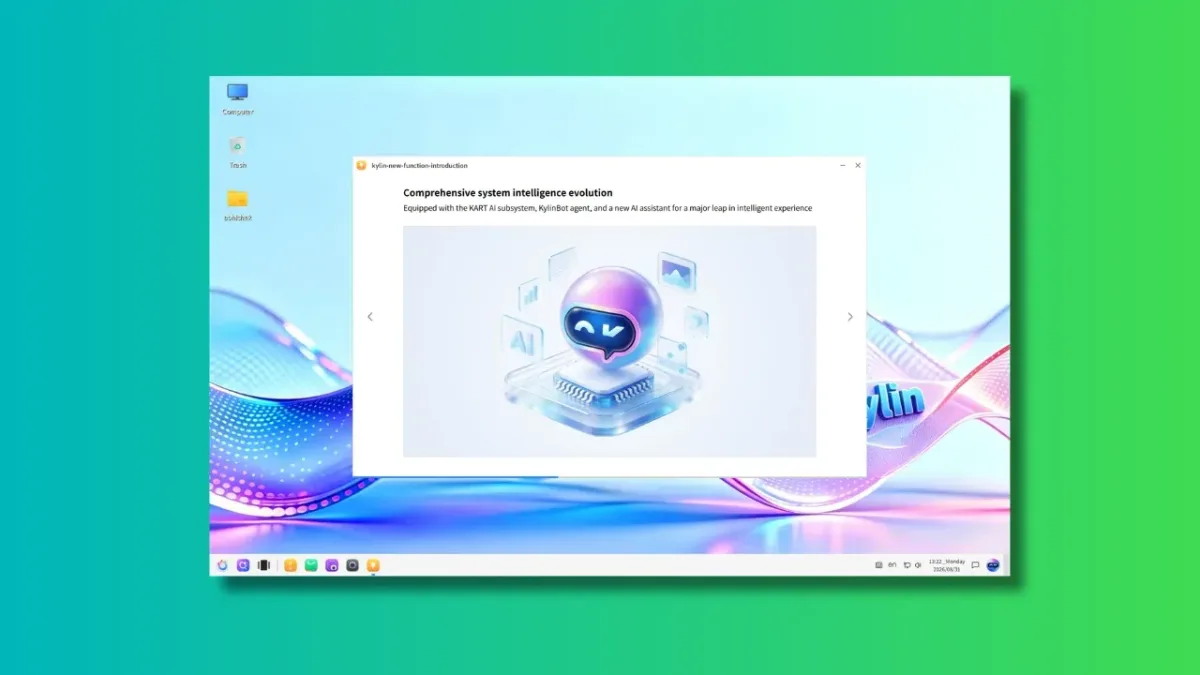
openKylin, an open-source operating system developed collaboratively by Chinese companies, research institutions, and community contributors, has reached version 3.0 with significant architectural changes. The release introduces Linux kernel 7.0, UKUI desktop environment 4.24, and positions artificial intelligence as a foundational component rather than an afterthought.
AI Integration at the Foundation
The centerpiece of openKylin 3.0 is the newly developed KylinBot AI agent framework, which powers Xiao K, a graphical AI assistant integrated throughout the system. Unlike standalone AI tools, Xiao K functions as a unified interface for system control, allowing users to issue voice or text commands rather than navigating menus or using the command line.
The framework comes equipped with pre-built system capabilities covering multiple domains:
- Input Devices: Complete support for keyboard, mouse, and touchpad management
- Display Control: Brightness adjustment and on-screen display settings
- Network Management: Integration with NetworkManager for Wi-Fi, Ethernet, and VPN configuration through unified commands
- Peripheral Management: Bluetooth toggling, device discovery, and automatic audio pairing
- System Controls: Power settings, taskbar operations, navigation shortcuts, and application management
Users can request actions such as disabling Bluetooth or switching networks through voice input, eliminating the need to access system settings or terminal commands. Beyond the desktop, Xiao K extends to messaging platforms including WeChat, Feishu, and DingTalk, with planned support for Telegram and Discord.
This approach aligns with broader industry trends. Ubuntu 26.10 is pursuing similar AI integration, while Omarch 4.0 has gained traction partly through its AI capabilities. As desktop operating systems increasingly adopt built-in AI assistants, openKylin positions itself ahead of competitors in this transition.
UKUI Desktop Environment 4.24
The UKUI (Ultimate Kylin User Interface) desktop environment advances to version 4.24, introducing standardized API encapsulation across modules and integration with KACP (Kylin Agent Control Protocol). This enables KylinBot to access desktop functions through unified interfaces.
Accessibility improvements include a built-in screen reader and air gesture controls, allowing users to manipulate the desktop through hand movements. On Android devices, this leverages the proximity sensor, while on desktop systems, the webcam captures hand gestures. Additional visual enhancements include dynamic wallpaper support and a new "Three-Island" taskbar layout option.
The touchpad receives expanded multi-finger gesture support, enabling users to access multitask view, adjust volume, and perform other actions using three-finger and four-finger gestures.
Rustification of Core Utilities
Following industry momentum around Rust, openKylin 3.0 replaces several legacy utilities with Rust-based alternatives. The new kylin-time utility supersedes the traditional time command, kylin-wget replaces wget, and kylin-ki18n replaces ki18n.
Availability and Installation
The openKylin 3.0 ISO image is available from the official website and exceeds 7 GB in size, primarily due to pre-installed AI models bundled with the distribution.