DIY enthusiast retrofits 15-year-old HP server with custom Raspberry Pi motherboard
A YouTuber designed and built his own circuit board around a Raspberry Pi Compute Module 5 to breathe new life into an aging HP ProLiant N40L micro-server, adding modern connectivity that the original hardware lacked.
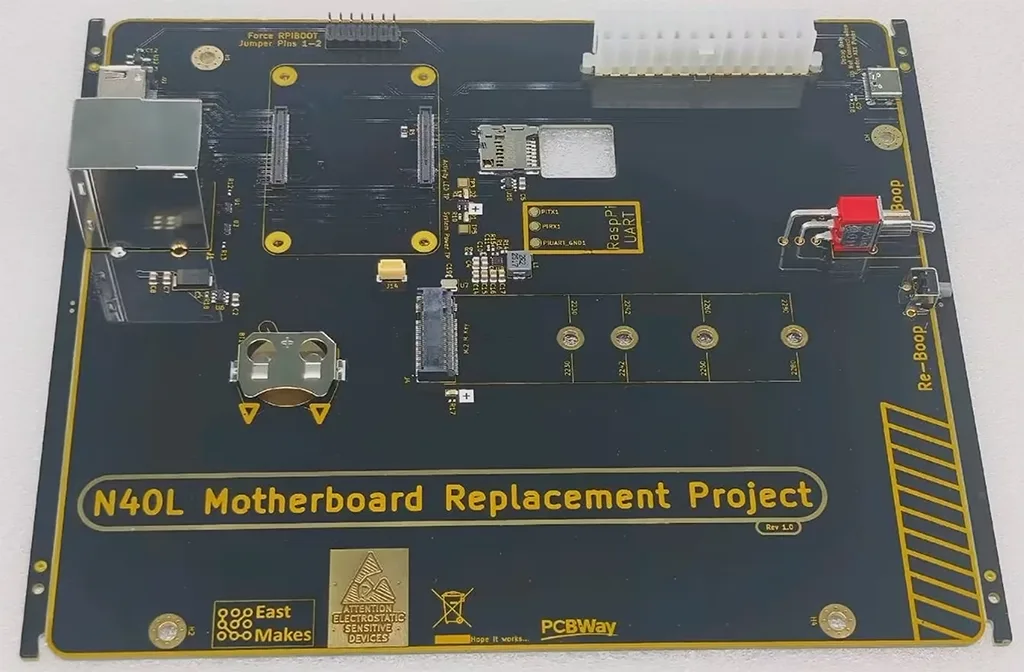
Discarding functional hardware with reusable components runs counter to the ethos of most technology enthusiasts, and YouTuber EastMakes found an opportunity to combine preservation with hands-on engineering. His target: an HP ProLiant N40L micro-server that had grown obsolete. Rather than consign it to the recycling bin, he engineered a replacement motherboard centered on a Raspberry Pi Compute Module 5 (CM5).
The original N40L presented several limitations that made it impractical for contemporary use. The system lacked any NVMe storage capability, offered only USB 2.0 connectivity, and its power efficiency metrics, once respectable, had become unremarkable. The onboard AMD Turion II processor delivered minimal computational performance—even when new, it struggled to match the capabilities of a modern Raspberry Pi, which would also consume significantly less electricity.
The CM5 functions identically to a standard Raspberry Pi 5 but arrives without integrated ports, requiring external components to provide connectivity. Manufacturers typically pair it with a dedicated I/O board, but EastMakes leveraged the Raspberry Pi ecosystem's open-source documentation to create his own custom variant. He scaled the board to match the N40L's original footprint and fabricated a 3D-printed prototype to verify port placements and mounting hole positions.
Subsequent refinements included consolidating to a single HDMI output and incorporating a stacked connector assembly housing an Ethernet port alongside two USB 3.0 Type-A connectors. An NVMe slot was integrated into the design for primary storage, with careful attention paid to trace routing to maintain signal integrity and prevent timing complications. EastMakes selected a distinctive yellow-on-black color scheme through PCBWay's manufacturing service and incorporated Boop and Reboop switches into the final design.
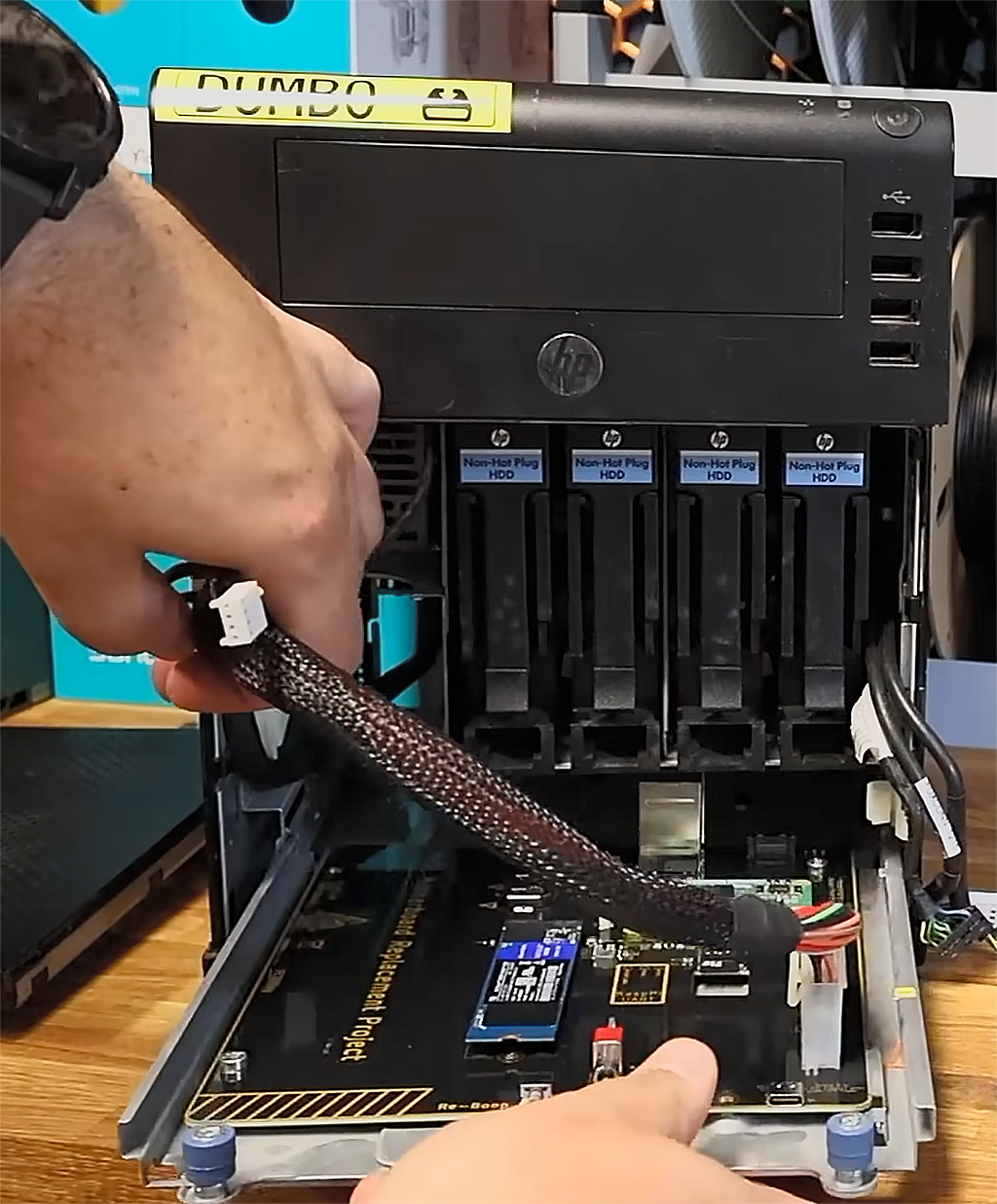
When the completed circuit board arrived, testing revealed immediate functionality—a result that EastMakes celebrated but that seasoned engineers recognize with caution. As any veteran developer understands, flawless performance on a first attempt often signals an undiscovered flaw lurking within the design. The board installed cleanly into the N40L chassis and booted without issue, with subsequent validation confirming that USB and Ethernet performance met specifications.
One feature remained unimplemented: the SFF-8087 connector for the hard drive bay. EastMakes' decision to defer this addition suggests plans for future expansion of the refurbished system.